
 ">
">


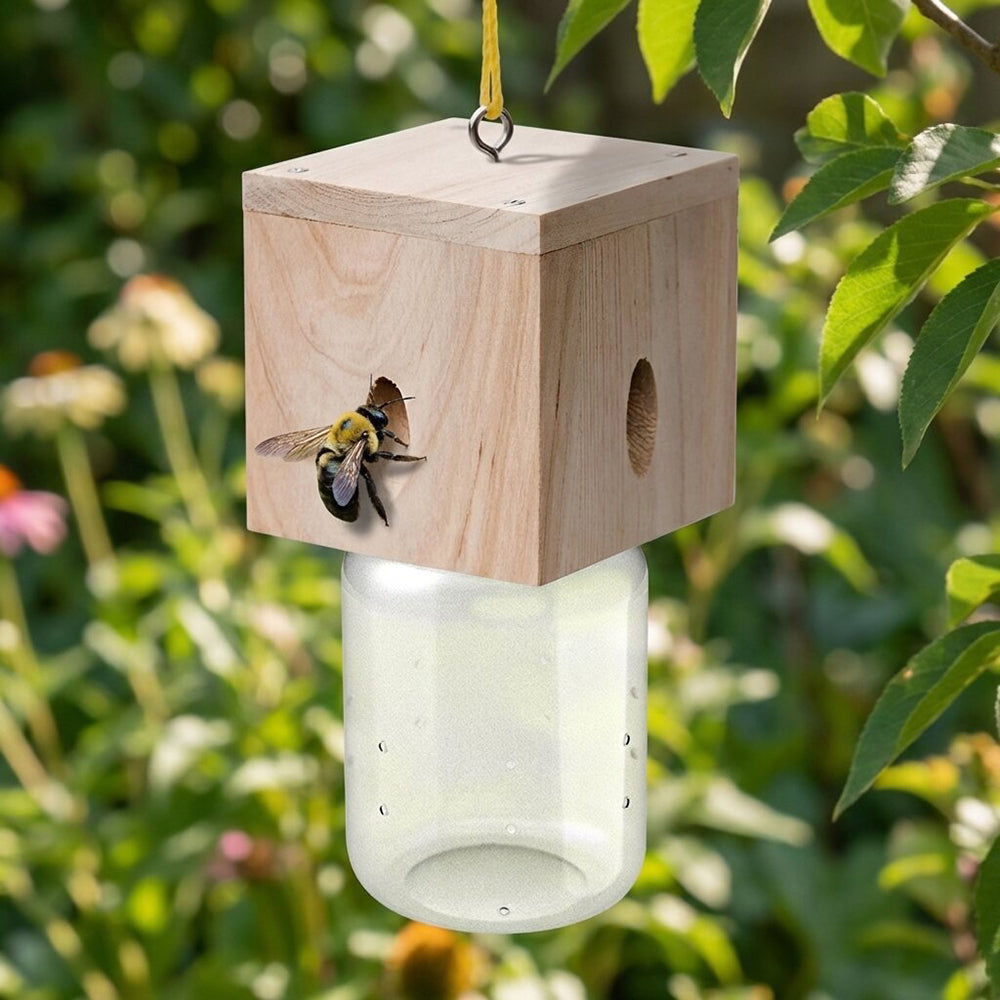
Minimalist Wooden Block Carpenter Bee Traps
- $25.99
- $25.99
- Unit price
- per
Tap Any Bundle To Shop & Save
Subtotal:
$25.99
 Free Shipping
 Fast Ships from USA
Couldn't load pickup availability
Why We Love It
xMinimalist Wooden Block Carpenter Bee Traps
- Self-Baiting Attraction System: This highly effective carpenter bee trap uses nature against itself. Once inside, captured bees naturally emit a scent to attract their peers, continually enhancing the trap's catching power without the need for added bait.
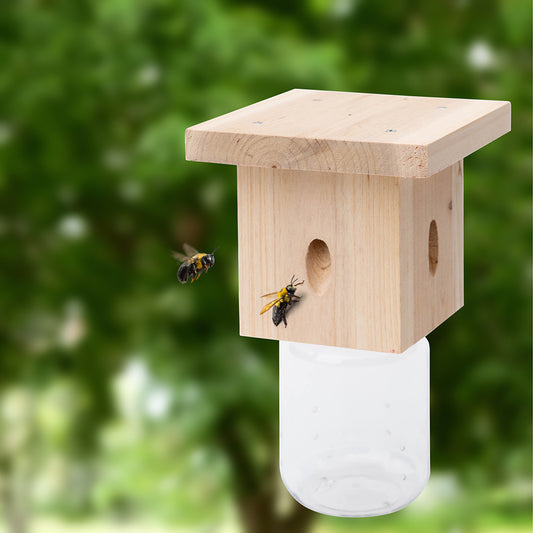
- Minimalist Cube Design & Low Profile: Crafted into a perfectly discreet wooden block, this minimalist unit acts as an authentic wood bee trap decoy. It blends seamlessly into any environment without being an eyesore, while destructive bees inherently trust and seek it out.
- Precision Entry Apertures: Featuring exact Φ 0.55” (Diameter) holes, specifically sized and angled to match the natural nesting preferences of wood-boring bees, making it far more effective than generic bee traps.
- Maximized Capacity, Minimized Footprint: Despite its tiny wooden body, it features the upgraded, wider Φ 3.0” clear collection jar for maximum catching capacity. Bottom venting prevents water accumulation, ensuring your bee trap stays dry, highly effective, and easy to empty.
- 100% Safe & Chemical-Free: Made entirely of solid natural wood with absolutely no chemicals or pesticides. It’s an eco-friendly solution to protect your home's exterior, completely safe for your family and pets.
- Durable Solid Construction: The solid block design leaves no weak points for the weather to exploit, ensuring your carpenter bees trap provides robust, long-lasting outdoor performance rain or shine.
- Ultra-Compact Overall Dimensions: The most space-saving option in our lineup. It features a total size of 3.5” W x 3.5” D x 7.8” H (Total height including jar; equivalent to 9 x 9 x 20cm). The main wooden body is a perfect 3.5” cube.
- Ready to Use: Arrives fully assembled and includes a sturdy yellow hanging cord. Simply unbox, attach the jar, and install it to start protecting your property immediately.
- Strategic Installation: Use the included cord to easily hang your carpenter bee traps on the sunny sides, corners, or underneath the eaves of your home for maximum catching effectiveness.
Best Bee Trap
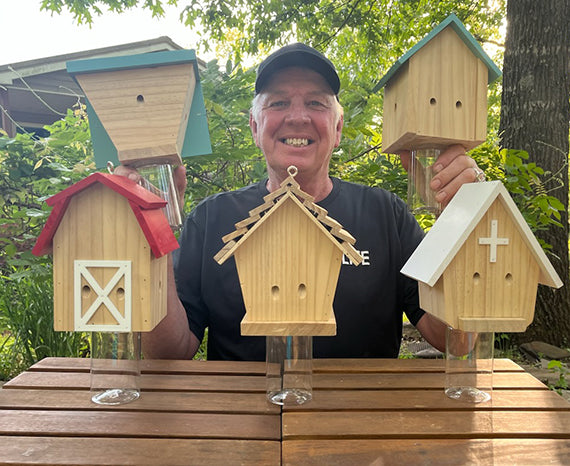
xThe best bee trap was invented and patented By Brian Blazer of Heflin, Alabama. Brian is an exotic animal farmer who built his farm house by hand from recycled wood. Shortly after completing his home, the Carpenter Bees began showing up on his property, burrowing into the wood, Brian didn't want to expose his farm and family to toxic chemi-als, and found the existing traps on the market ineffective.
Brian observed the Carpenter Bees and studied the habits to develop a solution. Over the course of several years, Brian tested many different trap designs before discovering the most effective trap.The Best Bee Trap!
The traps were initially sold locally to neighbors and friends, but good news has a way of spreading and soon the traps were sold from coast to coast across America. Brian patented his unique trap with the hope of helping other families protect their homes from Carpenter Bees.
Carpenter Bee Solutions
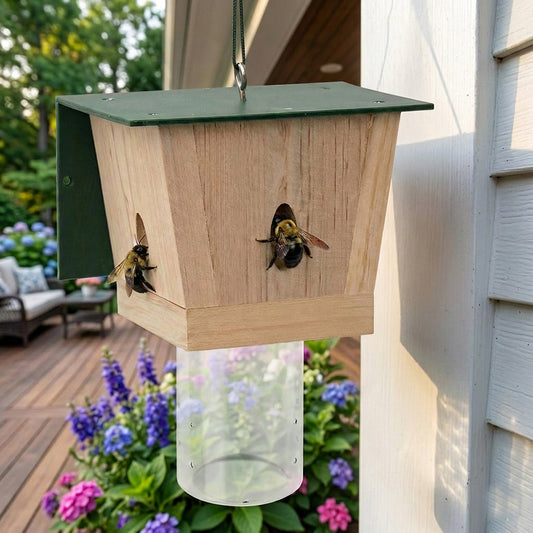
Hang your Best Bee Trap on the sunny side of your structure, High peaks and corners are prime locations.
Do not empty the trap unless it is full or has moisture in the jar. The dead and dying bees in the trap make it more effective.
Once well seasoned your trap becomes a BEE MAGNET To help control your bee problem. Be sure the receptacle stays dry inside. The bees drill upward holes to avoid moisture in the nest. Damp air is a BEE deterrent. Do not put any liquid in the trap.
Trouble Shooting tips : The nature of the bee.
When you see the bees hovering and fighting. This happens during the nesting season of bee. The male eastern carpenter bee has a yellow dot on his forehead. He will hover at spot to defend this spot from other males, He will chase almost anything that goes by. The good news is he does not sting, The female eastern carpenter bee with the solid blacklead DOES STING, Once the male establishes a territory, the female drills a hole in the wood making an elaborate nest chamber, Eggs are deposited in this nest chamber, Both male and female gather pollen and store it in this nest chamber for the larva to feed on once they hatch. During this time it is easy to see yellow streaks of pollen below the hole. lf you put your finger up in the hole SHE WILL STING!
lf you have a new structure the traps located properly will control your bee problem if you hang your trap near an existing bee hole. The male bee guarding that territory chases all the other bees away from the trap, This is because he is guarding a nest. To make your trap effective in this spot the hole in your structure should be plugged, caulked , or treated.
Shipping & Return
xWhat qualifies for free shipping?
We Free shipping on All Orders. Free shipping does not apply to Alaska, Hawaii, Puerto Rico, and Canada.
There is no coupon code required to receive free shipping, it is automatically applied at checkout.
Best Bee Trap reserves the right to substitute or cancel offers anytime. No rain checks. Not valid on previous purchases.
When will my Best Bee Trap order be packaged and shipped?
Best Bee Trap, LLC ship orders Monday through Friday, excluding holidays determined by common and other freight carriers. Any orders placed before 1:00 pm CT will be processed same day. Any orders after 1:00 pm CT will be processed and shipped out the next business day. However, depending on order volume order it may take a little longer. Please note, the first day of shipping starts after the order is processed.
Best Bee Trap delivery time frames will depend on the service level offered. However, most of our orders arrive within 1 day after processed throughout the United States. Some locations may take additional time to deliver. Faster delivery options may be available for a fee.
If I want to ship my order to arrive next day, when is the order cut off?
In order to guarantee next day orders to ship on time, an order must be placed by 11:59 am CT. Any next day orders placed 12:00 pm CT or later will process and ship the next business day.
What shipping options are available?
For each individual order, we select a shipping method to provide both value and speedy delivery.
Where can I ship my Best Bee Trap order?
Best Bee Trap can ship products to all 50 states within the United States (including Washington D.C.). Unfortunately, we do not currently offer shipping to the following US Territories:

How long does shipping take?
Once your order has been processed, you can expect standard shipping to be delivered within three-five days for most of the United States.
What if one of the products I ordered isn’t in stock?
Here at Best Bee Trap, we do our best to ensure sufficient inventory for all of our products. In the case inventory is not available, there will be a lead time to receive the product to the U.S. facility. The lead time is dependent upon the manner of transit and other natural occurring events.
How are my shipping costs estimated?
We get it, shipping can add up fast! With that being said, we do our best to offer the best shipping price. Our shipping costs are calculated in real-time with each carrier. Essentially the weight of your order and where it is going is calculated from USPS, FedEx or UPS. It's that simple.
No shipping shenanigans here.
Why is my tracking number not working?
If you chose to ship your Best Bee Trap order with FedEx SmartPost® there may be a delay in tracking your order. Since FedEx SmartPost® works with the United States Post Office (USPS) your order is not assigned a tracking number until it arrives at your local post office. Once your package is scanned at your local post office, you will be able to track your order -- this may be a day or two before your package arrives. With that being said, we will not be able to track your package any earlier than it arriving at your local post office. We apologize for any inconvenience this may cause.
Can I ship my Best Bee Trap order internationally?
Currently, we do not offer international shipping. If you intend to ship the product outside of the United States on your own terms, you are responsible for the payment of any import taxes, duties, tariffs or similar charges which may be imposed over and above ordinary shipping charges.
If I am returning a product, do I have to pay for shipping?
If we made a mistake, we will make up for it by paying for the return shipping. However, if you have changed your mind about the product, you will need to pay for the return shipping. To request a return authorization for a valid return, please visit our return policy page.
Additional Shipping Information:
All of Best Bee Trap orders are set to FOB Destination. Thus, ownership passes to the buyer upon the arrival of the product to the buyer’s specified delivery address. The title and risk of loss passes to the buyer upon the arrival of the goods at the destination, unless within 48 hours after arrival the buyer provides notice to the seller the goods are non-conforming.

THE BEST BEE TRAP
I KILLED 30 WITH A TENNIS RACKET YESTERDAY !! Why do l have MORE TODAY ?? This is a common problem. You see the bees you killed were males hovering to establish or guard a territory. (these have yellow dots on their foreheads) What was left was only the females. Now the girls are releasing a pheromone to attract a mate. This pheromone is actually drawing more bees to your location. Much better to trap them. Then both sexes are evenly trapped and you are not adding to the problem.
My Trap worked great last year. IT STOPPED WORKING! What happened??
Chances are your trap has a different resident. Either a wasp or spider is using your trap house. Remove the receptacle and take a look inside. lf you see live wasps or spiders, we suggest placing a plastic bag over your entire trap.Then you can seal the bag and place it in the freezer. Once frozen you can take a stick and clean them out. Remember freezing these insects doesn't kill them, lt makes them dormant so you can safely remove them .So remove them outside. lf you remove them in the trash in your house they will come to life when they warm up.
These are tips From the inventor Brian Blazer. Our detailed study on the Eastern Carpenter Bee is exactly how we came up with this trap and these instructions. Happy trapping.
Our carpenter bee traps stand out with superior quality and craftsmanship. Perfectly sized to attract and trap bees . Made with the perfect wood to attract the nesting carpenter bee . Pesticide free they are completely safe around children and pets .
Have an awesome blessed day,
Brian Blazer

Related Products
Example product title
- from $25.99
$103.96- from $25.99
- Unit price
- per
Example product title
- from $25.99
$103.96- from $25.99
- Unit price
- per
Example product title
- from $25.99
$103.96- from $25.99
- Unit price
- per
Example product title
- from $25.99
$103.96- from $25.99
- Unit price
- per
Example product title
- from $25.99
$103.96- from $25.99
- Unit price
- per
Example product title
- from $25.99
$103.96- from $25.99
- Unit price
- per
Example product title
- from $25.99
$103.96- from $25.99
- Unit price
- per
Example product title
- from $25.99
$103.96- from $25.99
- Unit price
- per
Example product title
- from $25.99
$103.96- from $25.99
- Unit price
- per
Example product title
- from $25.99
$103.96- from $25.99
- Unit price
- per
Recently Viewed Products
Example product title
- from $25.99
$103.96- from $25.99
- Unit price
- per
Example product title
- from $25.99
$103.96- from $25.99
- Unit price
- per
Example product title
- from $25.99
$103.96- from $25.99
- Unit price
- per
Example product title
- from $25.99
$103.96- from $25.99
- Unit price
- per
Example product title
- from $25.99
$103.96- from $25.99
- Unit price
- per
Example product title
- from $25.99
$103.96- from $25.99
- Unit price
- per
Example product title
- from $25.99
$103.96- from $25.99
- Unit price
- per
Example product title
- from $25.99
$103.96- from $25.99
- Unit price
- per
Example product title
- from $25.99
$103.96- from $25.99
- Unit price
- per
Example product title
- from $25.99
$103.96- from $25.99
- Unit price
- per

Learn More
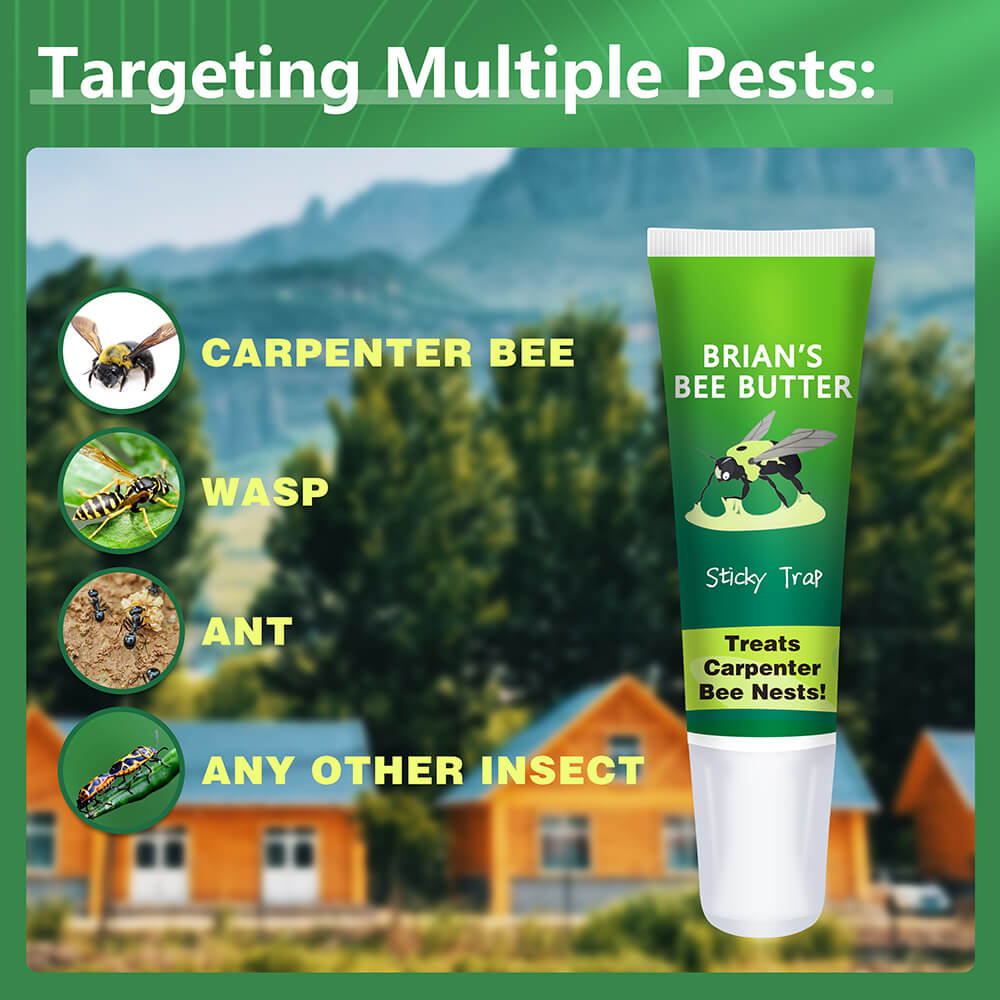
Brian's Bee Butter Carpenter Bee
$17.90
Limited Time
- Choosing a selection results in a full page refresh.